



Over the past six months, we’ve seen a surge in clients asking for support with their Gen-AI transformation efforts. There’s a growing recognition that Gen AI is not just another technological shift—it’s a transformation unlike any before. As businesses move from pilots to full-scale adoption, they can’t afford to overlook the psychological responses to this change. Working closely with heads of AI and digital transformation leaders, we’ve gained an understanding into why Gen AI adoption demands a distinct approach, how it diverges from past digital transformations, and why the human side of change is now more crucial than ever.

Why AI adoption needs a different approach
- It’s learning by doing like never before – in training teams around Gen-AI we learnt very quickly that Gen AI is best understood through hands-on exploration, as its power truly unfolds when people use it directly. Unlike past digital transformations, there are no strict guidelines; it’s intuitive, and personal discovery is essential for shifting mindsets and forming a new relationship with technology.
Overcome this by: Leaders need to trust their teams’ abilities to explore and grow. Encourage this with behavioral nudges that build confidence, and set up regular touchpoints for sharing successes, failures, and innovations.
- People come to AI with diverse perceptions, biases and expectations – Gen-AI is forcing people to reflect on the purpose and meaning of work, and critically their role within it (self-determination theory). The fear of the unknown, combined with the status-quo bias means people are reacting in more extreme ways, and there is far more loss aversion to overcome. Layer on top of that change fatigue from years of digital transformation efforts, and you’ve got yourself a pressure cooker for resistance.
Overcome this by: meeting people where they’re at, overcommunicating and being completely transparent (and human) about both the tools and their limitations, and about the change curve people may experience. Whatever you do, don’t let resistance hold you back, go where the energy is (because there’s as much curiosity as there is resistance) and create moments in time for celebration, excitement and engagement.
- Building the plane while it’s taking off couldn’t be more true – In many cases organisations don’t know what the future state looks like. They may have a few use cases which are essential in telling the story and showing potential, but the end goal is still unclear. Tools are evolving and being built every day, we’ve only just scratched the surface of what the possibilities are. For many, that’s exciting, for others it brings a sense of uncertainty and fear. Lewin’s Change Model which encourages organisations to unfreeze, change then refreeze must happen simultaneously or at record-speed to be successful. In many ways the ‘refreeze’ stage isn’t possible; people will constantly be in the state of flux. A growth mindset becomes essential.
Overcome this by: Tackling it and explaining it head on. Don’t try and pretend to have all the answers. Involve people in the process of defining the destination but leave that open to evolution as more knowledge is built.
- Safety is paramount (both psychological and legal) – creating a culture of constant experimentation is essential, and that is only possible if psychological safety is in place. People need to feel comfortable to try and fail, whilst critically understanding the guardrails, legal and ethical implications particularly when Automation Bias can lead us to over-trust AI outputs. It’s in many ways a juxtaposition, one that requires careful thought and a highly tailored approach.
Overcome this by: Be clear about the rules and open about the legal and compliance implications of using Gen AI. Invest in culture change efforts and behaviour change pilots to shift mindsets and ways of working. Critically, ensure leaders are driving accountability at the same time as creating the culture of psychological safety; a careful balance to strike.
- Leaders are learning too – whereas in most change programmes, top down leadership role modelling is the first priority, with Gen-AI adoption, the most senior leaders are often the last to adapt their ways of working. Of course, they know at an organisational level it needs to happen and are keen advocates, but on a personal level they’re often resistant to trying it themselves. This needs to be overcome, but at the same time your greatest influencers may not be who you expect.
Overcome this by: Invest in 1:1 coaching with leaders to help overcome any fear or resistance. Focus on creating a groundswell of influencers and champions at all levels of the organisation, use your Gen Z employees, give them a voice at the table of decision making, offer reverse coaching experiences for managers.
This is arguably the biggest shake up of work as we know it since the first Industrial Revolution. To overlook the human aspect of this change would be to admit defeat before you’ve even begun. Join us at the upcoming Business Change Conference on 27 November where we’ll be joined by in-house Gen-AI experts who’ll share their learnings of Gen-AI adoption.
#UnionizeStarbucks. #StarbucksWorkersUnited.
The collective outcry of disgruntled Starbucks employees this summer was just one of many examples of people taking their issues with working conditions to the court of public opinion – social media – that we have seen over the past few years. And they were effective. By month’s end, despite a US Supreme Court ruling that favored Starbucks, consumers were siding with the baristas, investors were selling their shares at a loss, and union negotiations were on track to deliver to workers a better contract.

Our new research shows that employees today are seeking agency – the ability to make an impact and the recognition for doing so – above all else from their employers. Those employers who do not offer opportunities for impact and value risk their employees grabbing it on their own terms, thereby changing consumer sentiment, influencing market valuations, and remaking their workplace.
This trend marks the latest evolution in how employees are engaging with their employers online; something we first observed in and have been tracking since 2014. That was the year of social campaigns so viral—remember the Ice Bucket Challenge?—they broke the Internet. Research we pioneered then revealed a startling development: engaging employees on social media resulted in brand messaging traveling 10X further than corporate channels. For organizations willing to invest in developing and empowering champion networks, the rewards were stratospheric—and the risks were low.
Fast forward to 2017, when we witnessed that advocacy morphing into something far more volatile. With one blog, you may recall, a disgruntled employee at Uber managed to dethrone its CEO. Research we conducted that year affirmed the trend: employees were gaining significant traction online by calling out their employer for unfair practices (real or perceived) or calling on them to take a stand on issues within or outside of the workplace. The risk/reward ratio, for employers, had dramatically reversed.
In 2021 and even more so today, we see that while winning brand advocacy is still possible, it’s by no means a given. To be sure, many employees have taken at least one action to advocate for their employers in the last 12 months—but these numbers have declined by close to or more than double digits since 2014. At the same time, employees’ activist positions have remained the same or slightly increased.

Faced with these headwinds, employers are not powerless. Our client work worldwide, bolstered by our ten years of research, highlights exactly how you can ride the momentum of employee advocacy while curbing the tide of rising employee activism.
- Understand and build a strategy to leverage the proven formula for building advocacy: multi-variate analysis shows that employees who feel 1) connected to and proud of their CEO, 2) that they have opportunities to develop and grow and 3) are generally satisfied with their workplace experience are significantly more likely to proactively advocate on behalf of their employers. Ensuring that employee engagement plans include robust executive visibility strategies, are tied closely to meaningful learning and development, and can be measured to ensure satisfaction will help improve outcomes.
- Address root causes of activism before they can sprout: employees who experience bad behavior in the workplace – from discrimination to micro aggressions – are understandably more likely to take a public position against their employer. There is no place for this toxicity at work, and employers must continue to do everything they can to identify it through culture risk assessments and remediate it by intervening where it persists.
Investing time in understanding what issues employees – and all important stakeholders – care about when it comes to navigating societal issues will also help get ahead of potential activism. A strong societal issues framework that balances stakeholder perspectives with organizational values and the realities of the business will allow for better coordinated planning as expected and emerging issues come up.
Based on the above, the questions we advise our clients to consider include:
- Do we create alignment across and points of connection with (C-suite, region, unit, site)?
- Do we have a plan for navigating societal issues to ensure consistency, speed and alignment?
- Are we consistently revisiting employee life-cycle from on-boarding to continued engagement with alumni for opportunities to strengthen engagement, learning and development?
- Are we facilitating mentorship and sponsorship across the organization?
While the proven approaches increasing employee advocacy and mitigating activism are relatively straightforward, they are anything but simple. We work closely with our colleagues at United Minds across North America, South America, Asia Pacific, Europe, Africa, and the Middle East to help clients anticipate, minimize and address organizational risk, while at the same time improving employee engagement, satisfaction, and ultimately, performance.
Published originally in Compass for the Chaos.
Leaders today face unprecedented risk if they fail to successfully navigate sharply conflicting demands from stakeholders both inside and outside of the company. Read about the real (but blinded) challenges leaders are facing over on the Page Society blog.
A global pandemic, digital transformations with the rise of AI, employee turnover, economic uncertainty, climate change, war even. And that’s just the last few years.
Leaders face unprecedented challenge
Leaders today face more challenge, more complexity and more volatility than ever before. Leaders operate under some of the most difficult economic, social and political pressures ever seen. They must be everything from bold visionaries, effective strategists to inspirational team leaders whilst also delivering business results month on month, quarter on quarter. And they face high expectations from a whole range of stakeholders – whether that’s delivering results to shareholders, providing competitive products and services for customers, operating sustainably and in service of the community and, last but certainly not least, delivering stable, meaningful work for employees.
It’s in this context that employees’ expectations on leaders are also changing. We are now in a world where the boundaries between personal and professional lives have blurred even further as the blessing and the curse of hybrid working has become the norm. And where employees are less reluctant to settle for anything less that contributing to meaningful, important work. We’re in a world where employees expect their leaders to show up as people first, business managers second.
Evidence and research tells us the most effective leaders lead with heart
From our recent Meeting the Moment survey of 1,000 employees based in the US and UK across a range of industries, business sizes and employee roles. We asked questions about the threats and challenges their companies were facing, the changes they were going through, what employees felt their leaders were doing well, and the impact this has on employee satisfaction, engagement and business performance. We found:
- When leaders don’t role model the right behaviours, this has a disproportionate impact on the satisfaction and retention of employees – more than under-resourcing, economic uncertainty, internal volatility or change, or a lack of a shared mission, vision and values. In other words, if leaders show up in the right way then employees will still believe in and follow them, even through a myriad of issues facing an organisation.
- The critical times for leaders to show up well is when there is a high degree of change or stress on employees – large scale transformation, M&A, change in strategy. Employees want leaders to show up with heart.
- The most important behaviours for leaders to display are listening, empathy, transparent communication and displaying trust that empowers people to take action. In fact, these are the behaviours that employees expect more of from their leaders:
- 3 in 4 employees believe leaders could demonstrate more empathy, and that leaders are no available or visible enough
- Only 1 in 4 believe leaders are excellent at articulating the vision and strategy
Leaders may be measured on business performance, but they can’t succeed without an energised, engaged and empowered workforce committed to the company’s purpose and their role in delivering the strategic results. A workforce that feels listened to and cared for as humans and that feels trusted and safe to collaborate, innovate, and learn, often during times of change. Evidence shows that the best leaders, those with the most impact, are those who are not just high-performing, but those that lead with a big heart and humanity.
Leadership development needs a rethink
Traditional leadership development has equipped leaders with the skills to build strategies, set objectives, track and measure performance and solve problems. However, frameworks, models and theories that serve a purpose in the classroom quickly get dusty in the real-world where leaders rely on their instincts, the views of those around them and the data in front of them.
Leadership development needs to do a better job at supporting leaders to be more human. We need to do better at equipping leaders to understand what motivates and drives their people. We need to curate the experiences that will push leaders to shift their thinking and see their role in a new way. And most of all, we must provide leaders with the skills and tools that allow them to focus on the people who deliver for their businesses, over the task, in the moments that matter most.
Nurturing high-performing leaders with heart
So how do we do it? At United Minds, we support leaders to first understand the psychology of their own habits and behaviours. What drives and motivates them, what holds them back, what’s behind their behaviours? By understanding how mindset affects behaviours – for both themselves and then for others – leaders can determine the actions that are right for them as individuals to show up authentically and that can be adopted straight away to shift outcomes.
The reason this approach is powerful is that it nurtures the essence of being a leader. It nurtures those core leadership skills that can be applied regardless of the environment. Whether it’s financial pressure, organisational restructure, the introduction of technology, leadership transition, organisational culture and employee retention issues, or outside-in economic, societal or environmental forces. By focusing on a leaders’ psychological awareness and behaviours, we are nurturing the leaders our businesses need today regardless of the challenge they face.
That’s why, we believe that more human leaders are better able to take on the challenges they face in the real-world. When we upskill leaders to understand their psychology and to lead with both heart and compassion, we’re equipping them to navigate and perform effectively, regardless of the challenge they face. And when we get it right, we get leaders who can drive business performance and a great employee experience.
Our three-step model to developing high-performing leaders with heart
Via our collaboration with Professor Thomas Roulet, Professor of Organisational Sociology & Leadership at Cambridge University’s Judge Business School, and based on his research and thought leadership, we apply a three-step model to the development of high-performing leaders with heart.
We start with the individual – the first critical step for any leader wanting to be effective and impactful in leading teams and organisations.

- Leading self
Leaders must first and foremost get absolutely clear on their own purpose and vision. Through self-awareness and reflection, leaders can understand the psychology of their own habits and behaviours. Then they create actions that can be adopted straight away to shift those behaviours, showing up in the organisation with a conscious and authentic leadership style. - Leading others
An effective leader aligns a team around their vision, provides focus and empowers their people to take ownership and make the decisions that will deliver high-performance. Through behaving with heart, compassion and great communication, leaders can support their teams through change and transformation, as well as create trusted relationships and safe environments that facilitate collaboration, creativity, innovation and productivity. - Leading organisation
With these foundations in place, organisational performance follows with a leader strategically positioned to drive results, nurture and drive an enabling culture through leadership role modelling, as well as clear, purposeful, strategic communications, and create the energy that will continue to drive a business forward as it continues to change, transform and evolve.
At United Minds, we are a group of HR practitioners, psychologists, coaches, business consultants, communicators, and change managers. It’s our purpose to make business more human and we believe that starts at the top.
That’s why we love partnering with our clients on leadership alignment and development programmes that nurture high-performing leaders with heart. For us, that’s leadership impact.
If you’re interested in learning more about what we do, get in touch.

Business leaders recognise that the pace of change is constantly increasing. Organisations are now expected to play a pivotal role in driving and sustaining long-lasting change in society. That’s hard to do without an authentic purpose that is lived and breathed by the whole organisation.
In a recent study of 1000 CEOs, 89% of their organisations had a purpose, but the CEOs’ biggest challenge was making it actionable and relevant. Connecting people to purpose requires everyone to be accountable for that purpose, and feel empowered to make decisions in pursuit of it. It can’t be left only to the leaders at the top.
However, change fatigue for employees is real. They need to be re-energised to build their creativity. How can we unlock the passion and joy people find in their work? How can we reignite the pride and purpose in our people without it feeling like yet another change initiative?
Empowering your team starts with you
The answer lies in empowering employees through clear accountability and devolved leadership. In a recent United Minds study of 1000 US and UK-based employees, 77% believe leaders could drive more accountability. Similarly, 75% believe leaders could empower employees more. For organisations to harness the opportunities within today’s rapidly changing business climate, it is critical for all employees to be accountable for the organisation’s success – and most importantly, to feel empowered to do so.
United Minds has developed a simple visual framework to help you explore, define and activate the critical factors needed to drive greater accountability and empowerment of your people. The ultimate benefit is creating the conditions for everyone to actively contribute towards strengthening your business.
The questions below will help you take a closer look at each of these critical factors.

Click here to review the full framework
The Why: Purpose, Vision and Strategy
You can only hit the target if you know what you are aiming at. People need to have a North Star to guide them when they are making decisions. Understanding the purpose, vision and strategy ensures their actions are aligned with the organisation’s priorities and its strategic intent for creating value.
Questions to help you explore The Why:
- Is our purpose/ reason for being and vision clearly defined?
- Do our employees feel connected to the purpose and vision? Do they understand the role they play to make these a reality?
- Are employees well-informed about the strategy, and do they understand how they contribute to its delivery?
Think about these questions from the point of view of the employee. As a leader, you will have a much closer connection to the business strategy and to the purpose and vision, and be clear on your role. Can you confidently – and measurably – say the same for your team?
The Way: Culture
Culture guides the “way things are done” in an organisation. Having a culture that is built on genuine vulnerability-based trust; that values feedback to enable honest conversations; and fosters a sense of agency to make decisions and take accountability without fear, ensures growth for individuals and better outcomes for the organisation.
Questions to help you explore The Way:
- What are the current levels of trust in your team? For example:
– Do managers trust the team to deliver results by providing guidance rather than by controlling everything?
– Do people feel safe to own up to shortcomings, and discuss their learnings from failures?
- Are you promoting a strong feedback culture?
A mature feedback culture is one where learning from past wins and failures is the norm, where teams are coached (not corrected) through mistakes and barriers, and where people feel safe to disagree and voice concerns, to reach a better outcome. - Are people in your organisation empowered to proactively step up to drive organisational goals?
– Ways to identify if you’re empowering your people include checking whether managers measure outcomes, not just inputs, and recognize the right behaviours in their teams.
– What stories are people sharing? Do they reinforce proactivity?
Are people in your organisation empowered to proactively step up to drive organisational goals?
– Ways to identify if you’re empowering your people include checking whether managers measure outcomes, not just inputs, and recognize the right behaviours in their teams.
– What stories are people sharing? Do they reinforce proactivity?
The How: Processes and Systems
Policies, processes and systems go some way to activating these critical factors and making the behaviour change more sustainable. These should be designed to promote and reward individual ownership, with defined responsibilities that create clarity and accountability without limiting initiative. Underpinning these should be measures on how improved empowerment and accountability tangibly impact business and purpose KPIs.
Questions to help you explore The How:
- Do the decision-making processes in your team/ organisation promote individual ownership and accountability?
- Are roles and responsibilities in your teams / projects well defined, with clear accountabilities?
- Does your organisation actively develop the right skills to enable devolved leadership? (critical thinking, thoughtful risk-taking, delegating, etc.).
Don’t do it alone
Now that you have explored the why, the way and the how behind enabling greater accountability and empowering your team to drive purpose-led change, it’s time to put it into action. Role model empowering your team by identifying people to develop a plan and put it into action. United Minds partners with organisations to design tailored solutions, starting with assessing where your culture currently is, and how you want it to evolve to get you closer to your Why. We support you in bringing your team along the journey through our people-centered approach – resulting in genuine empowerment and sustainable change, with a clear business impact in mind.
Click here to speak to us about how we can help.
Communications has never been so essential to business performance. But communicators are still not trusted at the same level as other C-suite leaders. It’s time that changes.
For several decades, the communications function has been maturing. Where once was a more straightforward playbook for connecting to key audiences – place an ad to reach customers, draft a press release to signal investors, write a memo to update employees, the 24-hour news cycle, information overload and a near-constant state of crisis has resulted in the need for a more strategic and nuanced approach.
And communications executives have been rising to the challenge. A poll conducted by The Weber Shandwick Collective in August of 2021 – roughly a year and a half into the global pandemic – revealed that at companies where communications were prioritized, employees felt significantly more loyal to their organization than those at companies who were not prioritizing communications (87% vs. 50%). Similarly, 80% of consumers preferred to make purchases from companies who were actively communicating policies that promoted employee health and safety.
Despite this track record of success, a lack of trust in the very leaders best equipped to manage company reputation has been stubbornly persistent. Additional research from United Minds and KRC Research shows While 77% of C-suite leaders consider communications and public relations as an area of focus for the company, behind only attracting and retaining talent (93%), managing the adoption of new technologies (90%) and addressing the impacts of inflation (91%), only 24% believe their company can deliver well in this area.
This lack of trust is creating serious business risk.
Communication leaders are generally very aligned to stakeholder expectations, according to insights gathered in partnership with USC Annenberg. This is especially true when it comes to perceptions of societal issues – an area where their C-suite peers are currently underestimating the importance to employees, customers and investors (even more so the Gen Z and Millennial members of these groups). What’s more, these leaders are not comfortable engaging around the issues that stakeholders believe are important. And only 27% feel comfortable addressing even one of the following topics: social inequities, climate change, geopolitical or domestic social issues.
A misalignment that is possibly leading to missteps.
Importance of ESG standards to stakeholder perceptions of a company
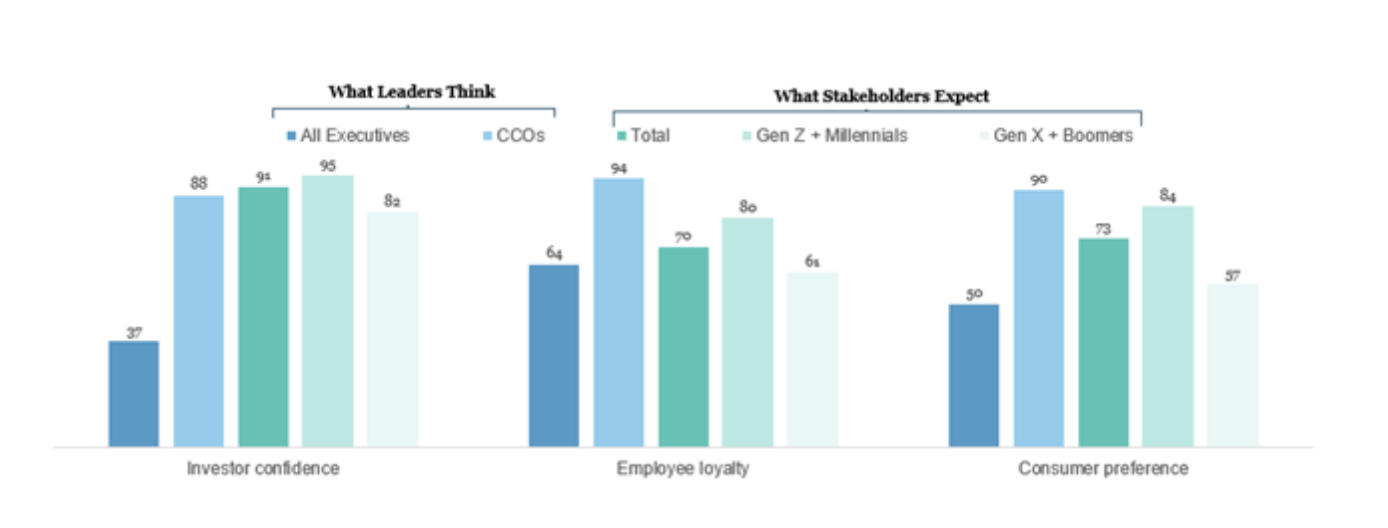
Companies who are discounting the expert guidance of communications’ leaders to engage – thoughtfully – around some more difficult topics are not realizing the benefits of doing so. According to findings from TWSC’s most recent public perceptions poll, employee satisfaction is much higher at companies where leadership speaks up: 72% vs. 39%. And consumers are making purchasing decisions based on company positions: 36% have chosen to “buycott,” intentionally buying products or services to show support.
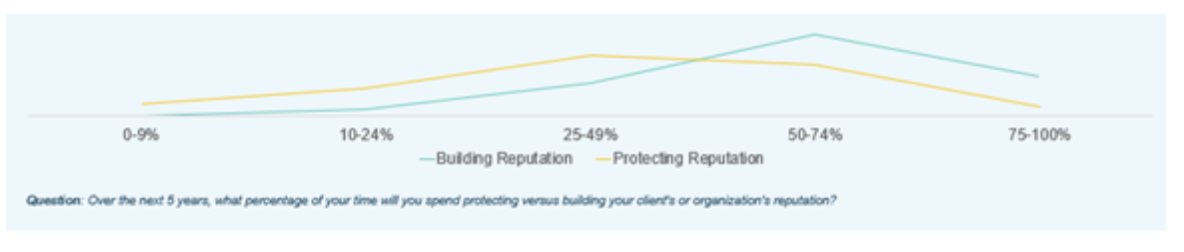
This doesn’t mean that communications leaders believe that every issue should be taken on publicly and bullishly. To the contrary, these leaders recognize that over the next five years, their job will become increasingly balanced between building reputation and protecting it.
Time spent protecting versus building reputation in the next five years
The stakes are high.
TWSC’s recent public perceptions poll also showed that even though 71% of U.S. adults believe companies should take action to address social issues, 45% see categorizing a company as “woke” as criticism. And 27% of employees who work at companies that have been called “woke” are fearful that their company will become the target of aggression and harassment.
This makes it even more important to trust the experts when it comes to preserving reputation while navigating complex, multi-stakeholder issues – or increasingly, the state of business.
So, how do communications leaders prove their value to C-suite peers and drive business success? Here are four ways:
- Shared intelligence: Every business must make trade-offs when it comes to prioritizing stakeholders, but in a model where responsibility for stakeholder engagement is divided across different teams, these decisions are often made in a vacuum. An integrated communication function offers a 360-degree view of stakeholders and a single point of responsibility in coordinating engagement versus piecing together competing priorities from across the organization.
- Shared narratives: A clear articulation of the business strategy, tied to company values, is critical to how a company is perceived by its stakeholders – and it requires nuances for each community. Communicators’ advanced understanding of stakeholder dynamics is critical to tailoring a narrative effectively and avoiding inconsistencies can lead to misunderstandings and frustration.
- Coordinated execution: Most business priorities require support from different communities at different times. Strategic communications leaders should be empowered to pull the right lever at the right time in a coordinated fashion across shared platforms to drive advocacy at scale.
- Shared accountability: Accountability shouldn’t be for the metrics of the individual function like reputation, employee engagement or policy wins. It’s for the business. Strategic alignment within communications functions means sharing the same goals while also maintaining discrete responsibility for the areas of impact necessary to achieve them.
It’s ironic, right? Communicators – the best positioned protectors of reputation – are suffering from reputational issues. It’s time these business strategists get the full support from their executive peers. Because they’re equipped to do the job.
The headline of Gallup’s recent State of the Global Workplace report states that “In today’s typical organisation, most employees are neither engaged nor actively disengaged.”

This isn’t surprising given the rise of quiet quitting, extensive change fatigue and ever-changing expectations of work. Yet, it’s also critical we don’t take this at surface value. Just because our employees aren’t actively engaged or disengaged, doesn’t mean they’re not experiencing a myriad of emotions in the workplace. Emotions that could be telling us a lot more than we realise.
According to Gallup’s study, nearly half of their respondents are stressed (and quite a few are angry). Anger is reported slightly higher in females (23%) than males (20%), and higher in South Asia (36%) and the Middle East (32%) than Europe (14%), Australia (15%) and Latin America (13%). US (18%) is fairly middling. Interestingly, intent to leave the business follows a similar pattern country by country showing serious financial implications if these emotions are not tackled and managed.
What needs to change?
For too long, the tendency has been to avoid, hide or even dismiss strong emotions in the workplace. Despite the shifts towards vulnerability in leadership, recognising and taking note of feelings, emotions and human reactions isn’t a widespread discipline. Even today, language around emotions is often seen as soft, unnecessary and completely disconnected from the business outcomes required.
At United Minds, a consultancy focused on making business more human, we’re out to prove that this line of thinking needs an evolution. Now more than ever, employees are increasingly being bombarded with new programmes to get behind, messages to disseminate, and in many cases, fundamental shifts to how they work on a day-to-day basis.
Without paying attention to the true emotions behind our workforce, how will we know if they’re truly supporting the changes that are coming down the track, how can we know how much change fatigue they’re really feeling and how can we possibly plan change management interventions that will actually work? By paying closer attention to these emotions, we can lead more effective change programmes, realise business results much faster and retain and engage more employees in the process.
Four ways to unlock emotions to drive change
- Create opportunities to share emotions – In a client workshop recently, we asked leaders to share where they were in the energy and state matrix. This useful tool acknowledges that no employee is going to be constantly in performance mode, that recovery time is needed, and that survival mode can only be sustained for so long before burnout becomes a reality. By creating a safe environment we identified that over 25% of the group were in survival or burnout mode; insight that allowed the senior leadership team to plan their transformation efforts and expectations they put on leaders more effectively.
- Use emotional insights to inform change management approaches – the best change management teams in the world don’t just blindly follow change management toolkits and theories. By taking a human approach to change, they create mechanisms and forums to capture and uncover emotional reactions in real time from the outset. Approaches like applying the SCARF model or listening activities to uncover real emotional responses. Then use this insight to create change management tactics that genuinely tackle these emotions.
- Train line managers and people leaders to identify and address emotional reactions – EQ remains a core skill of any business leader today. Organisations that take this seriously are hiring and training managers to be able to take this to the next level, specifically focusing on how to manage these reactions in a fast-changing environment. Approaches like displaying empathy, asking open questions and playing back what’s been heard to ensure people feel listened to then drawing on tools and techniques to manage the responses i.e. introducing frameworks like the energy matrix above. We’ve seen increases in requests for these kind of training programmes over the past year, with those participating reporting the importance and impact of investing in this area.
- Build self-awareness and resilience as core competencies – When people in the organisation are aware of their feelings and recognise them at work, it is more likely that they will be able to work with them in a way that will not be harmful for their mental health and disruptive in the workplace. This personal resilience can enable employees to find better ways to address stressful situations, be more focussed and productive in times of constant change and grow as individuals and professionals.
Try these strategies out and let us know how it goes. It may be uncomfortable at first, but we believe it’ll be worth it. For more information [email protected].
While the concept of stakeholder capitalism has become highly politicized – synonymous with woke corporations and the culture wars gripping pre-election America – the idea that a business need concern itself with more than just profits is as old as business itself.

Long before the Business Roundtable defined the purpose of a corporation as delivering long-term value to all stakeholders, that’s how business got done. The growth of the technology industry kicked off a war for talent that empowered employees wanting to make a ‘dent in the universe,’ to quote the late Steve Jobs. Purpose statements were written, employee value propositions were drafted and employers found themselves taking a stand on issues far outside their area of expertise and comfort; all in the interests of securing and retaining talent.
Customers, investors, employees, policymakers and activist groups share the same technology platforms. The ease of information dissemination creates an information fluency between communities that exposes every action corporations make to stakeholders who engage, purchase, invest and retaliate accordingly. A complex cacophony of competing, conflicting and often equally fact-based points of view is driving the social narrative and corporations are caught in the crossfire. Share prices have been hit and CEOs have lost their jobs, but after twenty years of competing for increasingly leveraged workforces, companies can’t back down.
At a Fortune town hall event last year, CEOs of leading global brands dismissed the backlash on corporate wokeness and ESG on the basis that it’s just good business. If the circular economy means their companies can appeal to workers and customers, reduce operating costs, AND benefit the planet, then not investing would be an act of self-sabotage. Unfortunately, different constituents have different opinions – multi-generational workforces disagree on what the company should stand for; some investors want long-term ESG growth and others want short-term profits. Inclusion is a challenging concept when a broad base of customers buy your products and those who don’t like your position are ready to activate in opposition.
All of this is the context for the rise of the corporate affairs function.
Corporate Affairs, like stakeholder capitalism is nothing new. At its base, it is the structural alignment of a company’s stakeholder engagement capabilities (comms, government relations, investor relatons, brand, etc.) into a single organization. Not, all things to all people, but dedicated specialists working side by side, aligned to the same priorities and reporting to the same leader.
Corporate Affairs has been common in heavily scrutinized industries like pharmaceuticals, aerospace and energy for years. Those industries can’t afford a misstep in government relations or communications that might put their broader business at risk. As those risks have spread to other industries, so has the practice. Many leading technology companies use a similar structure to manage rising government intervention in their affairs.
Risk mitigation is one motivating factor, but some companies are being proactive. They want to coordinate their policy agenda, investment thesis, ESG strategy and employee value proposition for impact amplification around critical business priorities.
A corporate affairs operating model can help. If all stakeholder engagement resources are organized on the basis of a shared framework of priorities, narrative and strategy then multiple levers can be pulled simultaneously to advance business goals.
Does that require structural alignment into one corporate affairs organization? No. The goal is strategic alignment. Structural integration is one way to get there – a ‘forced’ alignment that can reduce friction and waste between the units. Some organizations achieve the same objective by setting clear priorities that functions align around. It takes a firm hand from a leader actively engaged in stakeholder strategy, but it can be done with clear and effective governance.
However it’s structured, the most effective way to strategically align stakeholder functions is at four key points of intersection:
- Shared intelligence: every business makes trade offs between stakeholder communities, but without a single view of your multistakeholder environment, you’re hopping between those communities in a senseless balancing act. Executives report that this integrated, 360 degree view of stakeholders is one of the biggest benefits they receive from a corporate affairs leader on their Executive Committee. It means they don’t have to do the work of balancing competing priorities from across their organization and one person is accountable to coordinate the response.
- Shared narratives: narrative is a loaded term, but essentially it’s how you articulate your strategy and it requires nuances for each community. If its not 80 percent consistent, the inconsistencies can lead to misunderstandings and frustration, especially given the fluency of information between communities mentioned earlier.
- Coordinated execution: Most business priorities require support from different communities at different times. Pulling the right lever at the right time in an intentional and coordinated way is how sophisticated companies drive advocacy at scale.
- Shared accountability: It all starts and stops here. Accountability shouldn’t be for the metrics of the individual function like reputation, employee engagement or policy wins. It’s for the business. Strategic alignment means sharing the same goals and all being accountable for playing a part.
It’s possible over time that stakeholder dissonance will lessen. Workforce automation may reduce employee leverage and the consequent need to prioritize talent concerns against or over the concerns of shareholders or elected officials. Many companies will suffer before then. You don’t need to believe the role of a corporation is to serve employees or prioritize under-represented communities; you just need to know that in a multi-stakeholder economy, the path to profits is a minefield and everyone needs the same map.
United Minds is a Weber Shandwick consultancy dedicated to making business more human. To learn more, reach out to [email protected].
Focus, focus, focus. It’s the motto of choice for healthcare and pharmaceutical companies as former conglomerates divest to individual businesses. For pharma companies, this has created an opportunity to reaffirm their core strategic direction, moving companies like Merck, J&J and GSK away from multi-divisional and back to pure-play. Rumors abound of similar moves from other pharma giants.

For most recent examples of divestitures, it’s been the non-pharma elements of the business that received a new brand and identity: the pharma element retained the legacy brand (for regulatory reasons if nothing else). The case is clear for change management to support the new brand being spun out; less so for the resulting business which is perceived as mostly the same, at least by some audiences. But while end-customers such as HCPs may perceive little alteration, for other stakeholders like analysts and investors – and critically, employees – the effects of removing an organizational limb require planning new adaptations if the business is to thrive.
We’re seeing three main areas of concentration as pharma companies seek to redefine or refresh their purpose post-split. All of them require some degree of mindset shift for employees as the reshaped company settles into its new formation or looks to revitalize its pipeline. These include:
- Patient centricity. Most pharma companies have had this as a core element of their purpose for a long time, but internal and external perceptions of what this means can vary. Post-COVID, claims of patient centricity, and particularly issues of access, are under further scrutiny and companies need to walk the talk.
- Customer centricity and digitalization. Again COVID sparked this change, particularly in clinical trial management and in sales representatives’ interactions. The old models for both, long reliant on in-person relationship-building and monitoring, proved possible after all to shift to an online model, and as restrictions have disappeared companies are looking at how to retain the digital behavior efficiencies and improve on data and analytics capabilities.
- Innovation in R&D and supply chain. Despite investments in R&D growing over the last couple of decades[i], there hasn’t been a concomitant increase in speed or productivity. Companies are pushing hard for R&D productivity improvement in order to get more value out of the investments made.
All this means that the changes for employees in pharma business units post-divestment are just as great as in the spun-off units, without there being a handy new company identity for the change to hang its hat on. This can mean the pharma company risks being less immediate in its focus on managing its own organizational change, or is distracted by the operational aspects of all of the above points to address them as a true change management requirement.
Balancing employee expectations post-divestment
It’s easy for a divestment to appear as a narrowing of options rather than a refinement of business focus: even though the differing cultures often found in each segment of a conglomerate often preclude much internal migration. This is an important pillar of post-divestment messaging: what’s in it for employees as they assess their place in the new world?
Another overlooked consequence to divestment can be the loss of easy exposure to the strengths from each business. OTC is closer to FMCG in its speed, agility and customer sensitivity, particularly for divisions such as supply chain and marketing. These are all attributes that pharma companies are keen to translate to their own more measured, more heavily regulated environment: meaning they must be even more intentional on bringing in external inspiration and understanding how to apply it.
Tout the benefits, but don’t over-promise
As with all major organizational changes – regardless of the benefits to the business and the individual – employees will likely have an emotional reaction, questioning their future and allegiance. In the case of a spin, it’s a rare opportunity to re-define or re-align employees around the company purpose – but it must be done with intention.
This is the time to consider the priorities for employees and what’s in it for them as a result of the divestment. Where is the organizational focus and how is anything different from before? For example, allowing a business-as-usual mindset to continue is not only a missed opportunity to refine organizational focus; it’s a willful blindness that can constrain innovation just when the company needs it most.
An employee narrative can be helpful to setting or re-affirming a clear North Star for the business – a point around which employees can rally both practically and emotionally to re-energize commitment and pride. This should not neglect support functions who may previously have bridged across the former company, and because the operational complexity of a transition reverberates for a long time it’s important that the story is intentionally created to stay relevant for months or years.
This is the time to grasp the nettle of necessary organizational transformation and unite employees around the shared business focus with a positive mindset – embracing change for a progressive future, and not mourning the way things used to be.
Tips to build and sustain the right culture for your future
Wherever you are in the divestment cycle – planning, implementing, or post-split – it’s a long journey toward a new future as an organization.
Other steps you can take to best support employees who are living with unprecedented levels of on-the-job disruption and change:
- Never underestimate the power of the case for change. When articulating a divestment or the sole companies’ strategy, it needs to articulate and reinforce a compelling case for change that reflects what employees care about (e.g., improved patient care/health equity, removal of silos, greater agility/digital development, etc.).
- Engage people in shaping that vision. The vision needs to be congruent with the employee experience – where possible, employees should be involved to co-create a future they can see themselves in. And listen: a top complaint during transitions is that employees don’t feel heard. Set up channels and sessions for leadership to listen to employee concerns and answer questions to help reduce the resistance to change.
- Don’t skimp on culture. After a divestment is when the real work begins. But teams are often burnt out by the process of getting there. A re-alignment on the revised or reaffirmed culture requires consistent, long-term, sustained efforts, including ownership from key leaders and enablement of managers.
- Be transparent… and authentic. It will be as important to celebrate the wins and the milestones as it will be to acknowledge the setbacks. Arm and empower leaders with the information that they need to engage with their people thoughtfully and truthfully. Trust in leadership is a critical differentiator in a time of change. While they may be on-board to the rationale early, the management level a step or two below will be harder to engage and equip: and they are the critical first face to employees, so need to be authentic.
- Meet people where they are. In an age of increasing information overload, it’s more important than ever to understand and leverage existing rhythms and channels to ensure employee awareness and buy-in. Deliver the message where people will receive it. And repeat, repeat, repeat.
United Minds is a Weber Shandwick consultancy dedicated to making business more human. To learn more, reach out to [email protected].
[i] Source: Research and Development in the Pharmaceutical Industry https://www.cbo.gov/publication/57126 and https://invivo.pharmaintelligence.informa.com/IV146733/Pharma-Innovation-Europe-Is-Being-Edged-Into-Third-Place
The best leadership legacies inspire us to think boldly about the future. They compel us to reaffirm our own commitment to the cause and to move forward with a renewed sense of mission.
Yet too often, organizations struggle — seeking to balance the procedural aspects of leadership transitions against the preferences and calendars of the individual leaders. What gets lost in the swirl is a rare opportunity to engage employees and other stakeholders in a way that is personal, energizing and lasting. You’ve just been handed the keys to a catalyst.

As you plan your next CEO or c-suite transition, you’ll want to highlight your organization’s performance and the essential strengths and qualities of your outgoing and ascending leaders. And more importantly, consider how you might capitalize on this singular moment for the benefit of your stakeholders — modernizing the value of your organization and all it stands for through an authentic leadership lens.
Three considerations when ushering in a new leader
In any leadership transition, you are in effect framing and safeguarding three leadership legacies — the outgoing CEO’s, your new CEO’s and the legacy of your organization. It’s helpful to focus the transition on a few fundamental truths that are central to your organization and those it serves.
1. Start by looking for ways to broaden the conversation beyond the transition plan and key messages. For instance, you may identify genuine connections among leadership platforms, your business strategy and employee value proposition, your ESG commitments and innovation pathways — or your organization’s mission and the unique contribution that it makes to society. Use these connections to build relevance for stakeholders.
2. A transition is also an opportune time to develop or enhance the profiles of your senior leadership team. It’s less about creating “swim lanes” — which might give the impression that your leaders are each doing their own thing — and more about building alignment and amplifying distinct yet complementary viewpoints.
3.Think about your leadership culture overall. Is there more your organization can do to develop next-generation leaders — at all levels? How might your new CEO serve as their advocate and bring their voices and perspectives into the mix?
Now for the tactical side of things…
The following recommendations are designed to rally your stakeholders with a spirit of inclusivity and shared opportunity. Here are five considerations to employ as you transition from one CEO to the next:
- Celebrate colleagues and culture
In reflecting on the achievements that occurred during your outgoing CEO’s tenure, consider ways for the leader to elevate colleagues and the organization. Applaud individual passion yet emphasize collective effort. The valedictory message that your outgoing CEO shares with employees and other stakeholders should be brief, heartfelt, uplifting, forward-focused and most of all, inclusive.
- Lean into equity
If your organization made real progress with respect to diversity, equity and inclusion during the outgoing CEO’s tenure, now’s the time to cite it — and to reaffirm and ideally increase your commitment to continued improvement and growth. If progress on this front has been slow and sporadic, this is the moment to intensify efforts and accelerate.
- Elevate with common purpose
As you build the leadership platform for your incoming CEO, consider the ways it will rightly illustrate and humanize your organization’s enduring commitment to its mission — recognizing that it should evolve (and your employees should help drive that evolution). Stakeholders are always reassured by an appropriate measure of continuity, but they also have a keen interest in shaping and facilitating change that sparks new growth.
- Plan symbolic (and not-so-symbolic) acts
Because actions speak louder than words, your new CEO may wish to consider one or two highly visible and consequential leadership decisions or actions during their first weeks in the role to reinforce their message. Ideally, these actions would be designed to accelerate strategy, strengthen and differentiate the organization, mitigate risk or capture new opportunities.
- Be authentic and make moments count
“What’s his tweet for Thanksgiving going to be?” is a real question a stakeholder once asked a chief communications officer. And because the stakeholder was a senior leader with a steady interest in the CEO’s communications, addressing the query took a good amount of diplomacy and time. Avoid managing your new CEO’s platform reactively. They will be expected to speak out on a range of topics related to and well beyond your business, so get out in front of key issues and stay there. Sit down with your leader frequently, discussing areas they are passionate about and determine in advance — ahead of stakeholder pressure and watershed moments — where it’s vital for them to offer a point of view. Authentic advocacy on behalf of your organization and stakeholders should be a mark of your new CEO’s tenure, offering significant reputational and societal value.
When a leadership transition is successful, it honors not only the unique leadership traits and capabilities of both the outgoing CEO and the ascending CEO, but also the organization’s collective accomplishments within the context of a shared, overarching vision. For stakeholder audiences, the main focus must always return to the trajectory of the organization and the people it serves. And every milestone celebrated must predict further progress, championed by all.
United Minds is a Weber Shandwick consultancy dedicated to making business more human. To learn more, reach out to [email protected].


