



How to determine the right approach for your business and culture
For centuries – basically since the industrial revolution – most of society has shared the common experience of what it means to work. No matter what the work is, the process of coming together at a workspace has remained central to how work gets done. Or more literally: going to work.

The past three years have upended this, most likely for good. But while the disruption to past ways of working was cemented by the pandemic, it has only sped up a much longer technology-enabled transition to more flexible work arrangements.
This is one of the main reasons why there has not yet been an en masse “return to work” as was forecast as early as April 2020. Even so, many leaders are still looking for a silver bullet and the right answer for how to best manage their workforces as we look to the future.
The truth is, there isn’t one right answer. But there are better answers for different types of cultures, businesses and organizations.
For example, if silos are holding back the business, in-office interactions can help break these down. If innovation is critical, a balance of live collaboration and protected time for individual creativity might speed the path to success.
Rather than focusing on “returning” to work or even “going” to work, leaders should be intentionally designing policies that consider how to best bring people together to work.
Because getting it right is truly important.
Research from United Minds shows that hybrid workers are the most satisfied with their jobs, with over 6 in 7 feeling both loyal and proud to work for their employer (vs. 3 in 4 who are back in the office full time and 2 in 3 working from home full time). From a recruitment standpoint, Gen Z is most likely to value workplace flexibility (58%), especially when compared to Boomers (44%). At the same time, people working from home full time are the most at risk: more than half are worried about their mental health and wellness, they are experiencing burnout and are questioning job security – rates that are 10 to 70% higher than their hybrid and in-office peers.
Knowing that every organization is unique, let’s explore some of the common “work” structures:
- 100% in the workplace. This structure works best when the majority of work required is regulated and/or collaborative and iterative – and is especially effective where there was already a strong pre-pandemic culture. To further the success of requiring full-time in-person engagement, consider allocating and protecting adequate time and flexibility for employees to manage personal commitments and supporting and destigmatizing mental health and wellness.
- Hybrid multiple, specific days per week. When the work requires regular collaboration and protected time, this structure might be most successful – especially where employees (who may skew more early-career) appreciate clarity, constancy and supervision. Outcomes can be improved further by providing guidance on the types of work that are most effective in-person vs. at home and encouraging leaders and managers to reinforce the differences.
- Hybrid several days per month, at manager / employee discretion. If fewer meetings are needed to achieve business goals, this structure might make sense – especially when managers and employees have high levels of trust and open communication. Ensuring managers have training and support to maintain equity and navigate issues that might arise from a less-structured policy will help promote effective engagement.
- Hybrid a few times per year, tied to major meetings. Where a strong culture of autonomy exists and/or workers (who may have more responsibility at home) are geographically dispersed, this approach might increase equitability. With limited time together, it will be important to make it count by focusing not only on achieving meeting goals but on creating meaningful, on-going connections.
- 100% work from home. When business infrastructure and/or budget does not allow for people to come together, it might be necessary to work completely remotely. This approach might also make sense if the organization mutually decides this is the best structure. To best support employees, team leaders should consider codifying and leveraging what worked well from the past few years of working from home and building these best practices into organizational values and norms. Similar to those who are full-time in-office, fully remote employees might also need extra support when it comes to mental health and wellness but in the form of creating and reinforcing boundaries to support work/life balance.
Even the above general rules are not necessarily iron-clad and there is no such thing as a “set it and forget it” structure. Getting it right requires an on-going assessment of what is – and isn’t – working.
This means surveying employees both on preferences and levels of satisfaction and engagement, taking a hard look at key performance indicators to determine where you might be falling short and if there are trends that could be linked to current work arrangements. And finally, testing, learning and being open to making adjustments accordingly.
Ultimately, it’s very likely that multiple work arrangements will be present at organizations now and into the future. To successfully navigate the complexity of these arrangements, aligning workplace practices to support the culture you need to deliver on the business strategy is critical. So are frequent communications that reinforce this connection.
United Minds is a Weber Shandwick consultancy dedicated to making business more human. To learn more, reach out to [email protected].
An open-source approach to empowering your teams
This article is part of United Minds’ MoreHuman@Work series, a closer look at the changes and trends in the world of work and what they mean for organizations.
After more than three years of constant, pandemic-fuelled change, employees have had enough. They’re fatigued. They’re burned out. And they may balk at your next initiative – or worse, lend it tepid, performative support.
Seven of ten employees (71%) are overwhelmed by the amount of change at work. Eight of ten (83%) change-fatigued employees say their employer has not provided enough tools or resources to help them adapt. As a result, 60% of employees plan to change jobs in the next few years, with ~1 in 5 – in the next year.
The question is, what are you going to do about it? Can you fairly balance the needs of your employees against increasing pressure to transform your business to drive growth or profit? How will you keep your teams at their sharpest to meet tomorrow’s challenges swiftly and effectively?
Now could be the perfect time to open-source your change strategy – involving your people to shape how change should happen.
Chances are, you’ll be surprised how quickly your employees jump in – their degree of engagement and innovation –when they are simply afforded the opportunity to co-create change and get ahead of it rather than waiting for the next wave to fall upon them.
The open-source approach requires a bit of an organizational mindset shift. If your organization is more traditionally hierarchical, it requires a bigger one: eschewing the top-down view in favor of collaboration, building inclusive leaders at all levels, and sharing accountability. Here are five steps to get you there:
- Make sure purpose is at the heart: People want to do good, meaningful work and get recognized for it. It’s the key to engagement and productivity; it builds the essential resolve to rise to new challenges. Which is why employees at every level need to feel a personal connection with your purpose and understand the role they play in fulfilling it through their day-to-day work.
- Go all-in on accountability: Don’t delegate tasks – distribute authority, make decisions collaboratively, and make shared accountability your common language of success. You will quickly increase your organization’s operating tempo and build agility on an enterprise scale.
- Unleash your communications and let them work harder: You might have a pipeline strategy for talent, for growth and products. But do you have one for communications? Contemporary, high-performing communications should never merely push information. Open-source change entails interactive, collaborative, transparent communications, driving important conversations and creating a sustainable platform to co-create the future.
- Walk all the talk: It’s not enough for employees to “have a voice” and to “feel heard” – each employee needs to know that their voice matters and drives action. A collaborative approach to change includes gathering feedback from teams, acting on it, and course-correcting when concerns are raised.
- Create lasting value through trust: Employees who report high trust have a far greater capacity for change – more than 2.5 times greater than those with low levels of trust. By operating with a strong foundation of trust, always keeping employees’ needs front and center and transparently demonstrating your commitment to meet them, your employees will thrive in their careers and your organization will be well positioned to capitalize on more and bigger opportunities.
An open-source change strategy will make your organization far more agile, customer-focused, and responsive, built on rapid feedback from your front lines. Leadership still has an important role – but rather than imposing change from the top, your leaders will now be seen as ‘empowering partners’ who remove barriers to progress. You’ll change faster, reap the rewards sooner. And your formerly change-weary employees, newly energized with a sense of purpose and ownership, will become your most vital change champions.
United Minds is proud to announce the expansion of its global management consultancy with a new C-suite advisory: Myriant. Focused on business resiliency, Myriant will apply a stakeholder lens to advise clients on various risks and opportunities which often arise against today’s backdrop of geopolitical fractures, social and political polarization and misinformation. Combined with United Minds’ deep expertise in organizational transformation, Myriant offers everything from holistic insights and counsel to complex business decisions and developing stakeholder management strategies.

“Myriant applies the same rigor to the external stakeholder environment that United Minds as a culture change consultancy brings to the internal business environment,” said Ben Kalevitch, managing director, Myriant. “In both cases, we believe business decisions should integrate and align an individual company’s specific organizational objectives, resiliency considerations and the expectations of their specific stakeholders – which requires applying a multi-stakeholder lens to business strategy.”
Myriant’s management consultants utilize a network of advisors from business, government and politics, civil society and academia, along with industry exclusive, AI-backed analytics and insights. Myriant’s advisory areas include:
- Business Resiliency
- Stakeholder Management
- Emerging Risk Management
- Capital Markets Advisory
- ESG Advisory
- The Futures Media Lab
“For over a decade the United Minds team has advised hundreds of clients on the complexities of the workplace and so we have seen first-hand the myriad of business challenges facing leaders today. Where once the measure of a leadership was shareholder return, now leaders must understand and manage the needs and viewpoints of employees, investors, consumers and the communities in which they operate, to name a few. Put in the context of increasing polarization and mis- and disinformation and rapidly changing attitudes about the role of business in society, it’s clear that a new model is needed for providing counsel on maximizing impact and reducing risk,” said Kate Bullinger, CEO, United Minds.
Myriant launches with several client engagements including supporting a Fortune 100 company in spinning off one of its key divisions, providing stakeholder insights to the Board of Directors of a logistics company surrounding an operational crisis and counseling a top consumer brand on how to address a bot-driven attack on its reputation that has had a negative impact on its valuation.
Additionally, Myriant released a new study, featured earlier this month in Fast Company, conducted in partnership with the University of Southern California Annenberg School of Communication and Journalism. The study shows a company’s understanding and management of societal impacts has a direct effect on decision-making and behavior among employees, consumers and investors, including:
- Nine in 10 investors consider social and environmental impacts important when buying a company’s stock.
- Seven in 10 consumers and employees consider social and environmental issues when buying a product or service and joining or leaving a company, respectively.
Further illustrating challenges to keeping up with shifting expectations, Myriant research found that CEOs and C-suite recognize the importance of employee engagement to the success of the business but are not currently equipped to provided needed support.
- Three of the top-four areas of focus for these leaders are centered around employees, from attracting and retaining them (74%), to getting them to adopt new technologies (57%), to engaging and empowering them (41%).
- BUT leaders are clear-eyed on their limitations. Only 13-24% of leaders believe that they are performing very well in these areas.
Myriant is built as a new single point of entry for senior counsel that understand today’s new era of leadership, at scale and with speed.
To learn more about Myriant and its capabilities, visit: myriant.com
Adopting a “responsible marketing” approach helps companies protect against – and more quickly recover from – threats to company reputation.
Increasing polarization. Heightened demands to take a stand. Real business impacts for getting it wrong. Never has it been so important for businesses, brands and leaders to stand for something. Or more critical for potential related threats to be identified, considered and addressed. Added to the long list of growing expectations of executives are the roles of purpose champion and brand protector; positions that grow more complicated by the day.

Research shows that on average, companies that align their brand to a higher purpose achieve better business results. For example, when it comes to financial strength, brands that focus on improving quality of life outperform the stock market by 120%. Similarly, the modern workforce prioritizes culture, diversity, and high impact over financial benefits; and 63% of consumers prefer to purchase from purpose-driven brands.
But, as we are increasingly seeing, leading with purpose can also expose brands to reputational – and by extension business – risk. Watchdog organizations are tracking publicly-available information to either call out companies perceived as “woke” OR expose gaps between responsible business-focused statements and practice. Media coverage of topics considered “woke” trends negative, and companies can find themselves called out for either supporting or falling short of commitment.
While purpose-driven brands are experiencing increasing opportunities and challenges, they are not the only ones who are at risk. We are at a moment when the question is no longer if a brand will be called out but when and by whom. The most effective leaders will see this as an opportunity to prepare their organization to be strong enough to minimize and withstand threats to brand and reputation.
How? By adopting a “responsible marketing” approach and infrastructure.
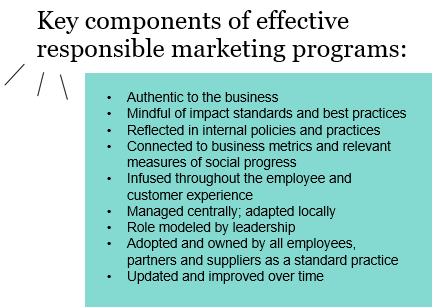
For years we have helped our clients to build back reputation with employees, consumers, regulators and investors following reputational crises. More recently as pressures to engage have mounted, we’ve worked with organizations across industries, including well-known brands, multinational companies and government agencies to get ahead of these issues by assessing and strengthening marketing and communications policies, protocols and systems and defining an approach to engaging around societal issues.
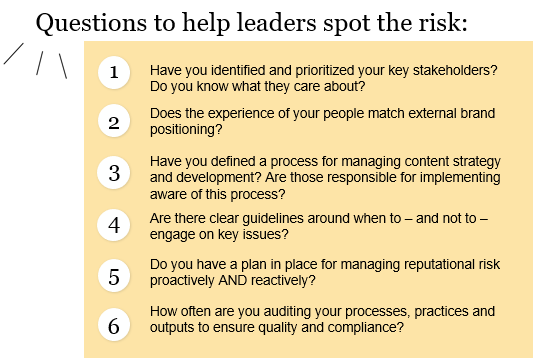
Here are the steps that all organizations should be taking to maximize brand value while at the same time minimizing risk:
- Define “Responsible Marketing” and supportive policies aligned to your brand. At the most basic level, organizations must start by simply and clearly articulating what responsible marketing means and why it matters to the company, and who benefits. The definition should be supported by foundational policies that guide how it is activated in marketing and communications programs.
- Expand internal policies into a published Code. Leaders can learn from companies in more highly-regulated industries such as food and beverage that take responsible marketing a step further through the development of a more formal “Code” that is aligned to mission, policies and impact standards. In many cases, these Codes are tied to broader company policies and also adapt guidance published by broader industry associations and non-profits such as the International Chamber of Commerce and World Health Organization.
- Establish a governance model including dedicated resources to protect investment in responsible marketing. Though everyone who has responsibility for enhancing and protecting brand also has responsibility for doing so responsibly, in order for a formal program to work it needs formal leadership. In many cases, this means bringing together existing resources and team members who might be operating in silos together into a more formal structure. In other cases, it means moving responsible marketing from being a side project to being a dedicated role with associated key performance indicators. Ultimately this team must work together to ensure accountability and oversight of the Code, including adherence and incorporating updates and best practices.
- Continue to revisit the Code. Stakeholder expectations change. Putting into practice a Code might expose areas that need to be strengthened. A Code should be considered a living document that is updated regularly, and at least annually, as the business context and media landscape evolves.
As the old adage says, the best offense is a good defense. In an environment where organizational accountability remains paramount, brands must do the hard work to define who they are and stand confidently in their values to maintain the credibility to protect against and respond to reputational threats.
United Minds is a Weber Shandwick consultancy dedicated to making business more human. To learn more, reach out to [email protected].
Attention leaders: you, and not just your board, can be held liable for brand-sabotaging behaviors at your organization. Recently in the United States a court ruling has set the precedent that C-suite leaders can be held personally accountable for allowing a toxic corporate culture that fosters bad behaviors such as sexual harassment, discrimination or other misconduct.
It’s yet one more reminder that cutting investment in company culture is not a good idea. Research shows that a positive employee experience helps achieve the organizational resiliency you need not only to weather economic downturns, but also to capitalize on market opportunities when the economy recovers. And experience shows us that an inclusive and equitable culture is one of the surest ways to protect your organization—and you—from potentially costly reputation risk.

Avoiding bad action by diagnosing (and addressing) broken systems
Corporate officers become liable, the landmark ruling makes clear, when they fail to heed reports of misconduct or fail to have established lines of communication by which those reports can reach them. But this behavior is indicative of a deeper danger: leaders’ inclination to curry external stakeholders’ favor at the expense of internal stakeholders’ wellbeing.
Just how dangerous is demonstrated by the compounding damage—financial, reputational, operational—that Tesla and its C-suite are incurring for overlooking years of bad behavior in its factories. After being ordered to pay a contractor $137 million (later reduced to $15 million) for racial discrimination in 2021, the electric car maker was hit with a wave of law suits in 2022 alleging racial discrimination and sexual harassment.
The litigation prompted one shareholder to sue the CEO and officers for “causing financial harm and irreparable damage to the company’s reputation” by fostering a “toxic workplace culture.” Tesla’s shares plummeted 8.5 percent on the news, and the suit subsequently uncovered findings of a 2018 employee survey wherein workers depicted an intimidating work environment and expressed concerns about the CEO’s leadership.
Though the company and CEO liability may prove singularly large, the culture that gave rise to it is, in our experience, all too common. That’s because healthy cultures—places where inclusive values govern every policy, practice, interaction, and communication—don’t just happen. Their construction and maintenance require the commitment of top leadership, a data-informed strategy and targeted, ongoing investment.
Committing to systemic, not symptomatic, investment
What might that look like? With a decade of supporting clients as they shape and protect culture, we recommend the following:
- A gap analysis of the variance between values and systems, processes, policies and practices. Ask and assess: Are your values evident in every transaction and interaction? Are your ways of working aligned to the outcomes you desire? Are your processes delivering equitable employee experiences? A thorough audit of your operation can reveal not just your cultural climate but precisely the policies and practices that give rise to it.
- A strategy that tackles root causes of inequity and the capabilities—including behavior modification—to execute on it. Too many cultural initiatives have a flavor-of-the-month quality that breeds skepticism among employees. Effective strategies seek to modify, through experiential learning, leader behaviors, as these are what dictate cultural norms.
- Crisis preparedness. While healthy cultures are less likely to be the target of hostile criticism, no brand is immune. That’s why preparing for a public relations crisis must be part of any culture investment strategy. It’s the best way to ensure sparks don’t find the air they need to set the brand ablaze. Implementing a fire drill that simulates a PR crisis on social media in real-time is one way to approach this. You’ll learn what you’re prepared for as an organization, where there are gaps in roles and responsibilities and the ways reputation risk can imperil financial security.
To be sure, this adds up to not a trifling investment. But the rewards for making it are a fraction of the millions of dollars you will spend on damage control, including possible litigation.
Recent research from United Minds, Weber Shandwick and KRC Research of C-suite executives across industries shows that workforce development and retention is seen as the top buffer against a recession and the top goal cited by over three out of four (76%). In fact, three of the top four areas leaders identify as areas of focus in 2023 center on employees: attracting and retaining talent; managing the adoption of new technology to advance business growth; employee engagement and activism. Finally, preparing for crises is now the C-suite’s remit. CEOs are far more likely than VPs (66% vs. 25%) to focus on crisis anticipation and mitigation.
A similar study of employee and consumer perspectives by our organizations demonstrates why these efforts are important. Regardless of the current market environment, our research shows that people want to feel supported by their employer and that their contributions are meaningful. Of 79 workplace factors we asked 2,800 workers across seven countries to rank by importance to employee experience, a positive work environment came up as number one, followed by feelings of appreciation for their contributions (number two) and motivation to do their best work (number three). What’s more, 73% of employees who report working in a positive environment are likely to stay vs. 10% who don’t, and 70% of employees who report feeling motivated are satisfied with their jobs vs. 6% who are not.
Using missteps to help you find your brand footing
In the UK, CEOs have been replaced and some taken intentional actions to improve because of toxic cultures — including the Confederation of Business Industry, Bon Appetit and Brewdog. And it extends beyond corporations into sport and law enforcement – essentially, all organizations benefit from adapting and maintaining an inclusive culture.
Shoring up your culture is just as valuable after a crisis as before one – because what stakeholders most want to see is that their activism catalyzed the internal growth necessary to prevent further harm. Indeed, a sincere mea culpa—coupled with actions underscoring its sincerity—can propel the brand forward. Whereas failure to acknowledge responsibility, let alone take action to detoxify culture, inflames and sustains public enmity.
Our work with Papa John’s, the international pizza franchise, illustrates just how much organizations can reap when they acknowledge systemic change is needed and undertake the arduous business of overhauling their culture from the inside out.
Papa John’s cultural risks were very publicly exposed in July 2018 when its founder uttered a racist slur on a conference call—behavior in keeping with his criticism of NFL kneeling protests in 2017 and the Affordable Care Act in 2012. We were engaged by the company to help make clear to all stakeholders—employees as well as customers and investors—that the founder did not represent the perspectives of the company’s 120,000 far more diverse employees. Through the “Voices” campaign, which featured employees and franchisees as spokespeople for the first time in company history, proved a turning point for the brand, driving negative social media down by 29% and boosting neutral/positive conversation by 73%.
But to the credit of Papa John’s new leadership, crisis mitigation was their first step in culture remediation. We continued to work together, bringing a team of crisis and issues, DEI and change management experts to foster a positive employee experience by enlisting them in innovation, encouraging their dialogue via two-way communication channels, and promoting and rewarding inclusive leader behaviors. By holding leaders accountable for progress on these initiatives, our engagement strategy closed the gap between stated values and accepted practices, employee attitudes and public perceptions.
An ounce of prevention
Greater market resiliency. Less risk, both in terms of talent attrition and reputation damage.
For both reasons, culture should continue to be prioritized as an investment. A recession is no reason to cut back, but rather an opportunity to double down on systemic change.
Because a rebounding market is the absolute worst time to be held accountable for long-festering cultural failures. No matter how deep your pockets—as a brand, as an organization or as an individual—you can’t afford it.
#
Eric Blankenbaker is Executive Vice President of Global Crisis for United Minds, part of The Weber Shandwick Collective, with a focus on culture and litigation communications. Executive Vice President of Culture, Equity and Inclusion Nadine Redd Blackburn spearheads the culture and strategy offerings at United Minds with a focus on behavior and systemic change.
Women’s fight for equality dates back over a hundred years. While Sylvia Pankhurst might have rejoiced to know that women living with the menopause are the fastest-growing demographic in the workplace, her joy would be tempered by the slowness of that workplace to accept that equal rights aren’t the same thing as equal needs.
Although many companies focus on employee wellbeing in general, when it comes to women’s health in the workplace, specific support is inconsistent at best. A few examples: In the UK, 48% of organizations have no official policy in place to support employees undergoing IVF – and 90% don’t provide any kind of menopause policy. And that’s for the obvious women-centric health conditions. Women also face unique mental health challenges, with research showing that women are almost twice as likely as men to be diagnosed with anxiety disorders and young women are almost three times as likely to experience a common mental health issue as compared to males. Women are also at higher risk of serious diabetes complications and more likely to experience serious side effects from cancer treatments.

Add to that the business impact of women’s health-related absences, which is clear. A 2019 study found that 14 million workdays were lost to the UK each year due to menopausal symptoms and nearly 60% of women have taken time off to tend to health issues. Yet a quarter of these women reported that they were uncomfortable disclosing to their employer why they needed time off. When it comes to fertility-related absence, more than half of women don’t disclose their IVF treatment to their employers, in part due to fear of losing their jobs or having their commitment questioned.
While evolution in legislative and organisational policy may be glacial, there is an opportunity for workplaces to take the lead in demonstrating a commitment to their employees’ health needs. Many are: Channel 4 has launched reproductive health and hormone testing for its employees, Co-op offers paid time off for fertility treatments and Bristol Myers Squibb1 was named Menopause Friendly Employer of the Year in 2022 for its holistic approach to menopause-friendly initiatives.
A catalyst for organizational change
In the same way that the global COVID-19 pandemic forced companies to re-think or create their approach to hybrid working, a closer focus on women’s health requirements makes the need for a changed approach obvious. Policy can’t drive culture by itself, but it can change behavior. It’s one of the variables which influences whether an organization is doing the right thing when it comes to women’s health, but it isn’t a panacea. Even without a policy framework, creating a culture of openness can help ensure that women feel safe to discuss their needs and collaborate with their teams and leaders to prioritize their health outcomes while minimizing business impact. This all starts with the relationship between employees and managers. Case in point: Almost two thirds of women said discussing IVF with managers or employers made their experience easier to deal with.
Making business more human is the cornerstone to achieving empathetic dialogue on sensitive subjects. Empathetic leadership is linked to higher performance and there is a raft of research and training courses available to encourage this behaviour. But when it comes to women’s health, more specific coaching and guidance may be needed. In issues that touch an employee’s most personal concerns, managers may fear saying the wrong thing and choose to say nothing at all.
As business leaders, try implementing these simple steps to begin cultivating a culture of open conversation and trust:
- Help managers learn to listen – and listen to learn: Having an open-door policy and being able to talk to managers and HR personnel about health concerns is key. Any health condition can be a sensitive and personal issue. And for conditions like the menopause, symptoms can manifest themselves in a visible way, creating greater embarrassment. Asking open questions can encourage people to share in a trusted environment and confidential conversation. This isn’t easy. It takes thought and preparation on both sides to have authentic conversations of this nature, and it isn’t in everyone’s natural comfort zone. Dialogue can be further complicated by personal life experiences or if the participants are different genders.
- Share stories and build peer support: Co-op’s chief executive shared her own experience of the difficulties in fertility treatment, which paved the way for the creation of policies to benefit all employees. Encouraging women, especially at senior leadership level, to speak up and become their own health advocates will help create the environment that normalises the conversation around women’s health. Setting up employee networks along the lines of ERGs, where employees can share experiences and provide mutual support, also helps to normalise the conversation.
- Educate on women’s health: Providing workplace education on women’s health or life transitions – the implications of fertility issues, for example – for employees (female and male) can help everyone be better informed. Greater understanding of the issues at a theoretical level can help when the implications become personal to a team. Any education also needs to guard against unconscious biases developing, or a backlash perception of discrimination.
With the continued increase in organisational focus on wellbeing, the time is right for a specific focus on women’s health. Maybe Sylvia Pankhurst would approve of the progress being made after all.
United Minds, part of The Weber Shandwick Collective, is a consultancy dedicated to making business more human. We help organizations navigate the people side of change including restructures, mergers, acquisitions and other significant transformations.
We are proud to be a lead member of The Weber Shandwick Collective: Women’s Health and to launch The Women’s Health Indicator. Developed by data analysts and behaviour experts, this proprietary product informs and identifies specific gaps in women’s health by analysing and assessing thousands of data points measured across society, media and policy.
Our team’s blend of psychology expertise, change management experience, strategic thinking and creative communications capability, means we can help organizations navigate complexity, position the change and avoid the pitfalls.
To maintain reputation in a volatile market, you’ve got to neutralize the potential saboteur. New data reveals who that’s likeliest to be—and how to go about it.
Restructuring and layoffs are an unfortunate reality for organisations right now as global economic conditions remain uncertain. The recent waves of layoffs we have seen in leading tech companies have provided powerful cases where leaders have acted with empathy and transparency.
But there are also cases where leaders have acted too impulsively, eroding trust with both the employees leaving and staying, resulting in damaged reputation and performance. Nobody wins from approaches like these, so what can other leaders learn from it?
Companies need to properly think through and plan the people side of their transformation efforts. This needs to be done upfront and with careful consideration, not as an afterthought. The change must then be done in a way that is truly human, empathetic and supportive. “Firm but fair” is a phrase for a reason; you can still make hard calls in the right way.
We’ve helped numerous organisations during times like this and the same advice stands true in almost every case. Whether it’s a restructure, down-sizing, divestment, separation, merger or acquisition, there is a simple principle to keep front of mind:
It’s not just what you do, it’s how you do it that matters.
Based on experience, there are three questions we’re asked in almost every single programme we’ve run.
How and when should we engage and communicate with people?
- Take a human approach. Communicate with genuine empathy, thinking through how people will respond and tailoring your approach, tone and language. You can use simple psychology and tools like the change curve to help plan
- Provide an anchor. Make sure the change aligns to your values and purpose so it is authentic and consistent
- Be timely and transparent. Confidentiality is usually a factor in these types of changes for legal reasons, but don’t leave it till the last minute to communicate. Also make sure to not only discuss what is happening but also why it’s happening and what it means for them
How do we manage risks?
- Risks usually start with people. Common risks associated with a sensitive change like a restructure (unforeseen walkouts, leaks, rumours, reputational issues) all involve people. Think through the psychology of change and how people will react and behave to inform the change and communications plan
- Scenario plan. Changes like these never go perfectly. Explore all the viable scenarios (including the potential fallouts) to inform your change strategy and plan
- Keep it tight, but not too tight. Keeping the “in-the-know” group to a minimum is wise at the beginning, but make sure you bring in leaders as early as possible. They’ll be going through the change curve too and will need time to process and prepare before briefing their teams
How do we remain adaptable?
- Build in listening points from the outset. As soon as you can communicate, start listening as well. Listening activities can make or break a change strategy. Feeling heard is the first step to employees coping with change, and gathering feedback will help you to manage potential risks
- Keep a pulse on wider organisational and external changes. Keep abreast of the latest developments or pivots in the organisational strategy so you can react fast and adjust the plan accordingly
- Review points are critical. Schedule regular formal touchpoints at the beginning and around critical announcements, so you are reviewing feedback and managing risks, before reducing the cadence as you get into the change
Want to talk through your upcoming change or further understand best practices? Send us a note ([email protected]). We’re happy to chat.
United Minds is a consultancy dedicated to making business more human. We help organisations navigate the people side of change including restructures, mergers, acquisitions and other significant transformations.
With our team’s blend of psychology expertise, change management experience, strategic thinking, and creative communications capability, we can help organisations navigate complexity, position the change, and avoid the pitfalls.
The last two years have tested leaders in ways previously unthought of. In fact, it could be argued that the job description for C-Suite Leaders has been rewritten entirely; focusing on running a successful business today means being able to understand – and engage with – an ever-growing list of stakeholders on issues related not only to operations but broader impact. And employees have solidified their position at the top of this list.
To understand how leaders are navigating these new expectations, we partnered with KRC Research to survey over 100 executives. And to hold them accountable, KRC Research also polled 500 employees on a variety of topics, including their perceptions of leader performance.
What the executives are saying
We found that – despite growing economic and societal pressures – leaders maintain a balanced outlook. While 57% say the current national economy is weak, 75% say their company is growing (and 21% say it’s staying the same).
More than three quarters of leaders (76%) see workforce development, reducing employee turnover and talent retention as a key buffer against recession – significantly more than any other area.
So it’s not surprising that three of the top-four areas of focus that these leaders are building into 2023 business planning are centered around employees, from attracting and retaining them (74%), to getting them to adopt new technologies (57%), to engaging and empowering them (41%).
BUT leaders are clear-eyed on their limitations. Only 13-24% of leaders believe that they are performing very well in these areas. And they are right to be worried.
How this compares to employee perceptions
Employees also have a balanced outlook on their companies’ ability to weather the current environment. Though slightly less bullish, more employees are optimistic (31%) than pessimistic (16%) about the future success of their organization. This is reversed when it comes to the over-all economy, where more are pessimistic (38%) than optimistic (26%).
As far as employees’ personal experience at work, there are several red flags that leaders should be watching out for. About half worry about their mental health and wellness (55%) and turnover within their organization (50%). More than a third fear more layoffs (39%) including impact to their own jobs (36%).
Even so, a vast majority (75%) say that they that their employer is taking the right steps to preserve jobs in an economic downturn and that they feel loyal to their employer (74%). But that isn’t stopping them from looking. Nearly 60% plan to change jobs over the next few years, including nearly one in five (19%) in the next year.
Keys to employee retention/attraction
One area where leaders and employees are aligned is the increasing importance of advancing not only business but society. Nearly six in 10 (59%) leaders report that their employees expect them to take a stand on societal issues, and that this is a critical piece of their ability to attract and retain them. Nearly six in 10 employees (59%) say that companies have a responsibility to speak up.
But that doesn’t tell the full story. When drilling down further, a bigger majority of employees identify as important a wide range of specific issues. For example, about eight in 10 believe their employers should give back to local communities (82%) and make company decisions that are sustainable and protect the environment and climate (78%). Three in four think companies should advance racial equality and address systemic racism (74%). Far less – six in 10 – think their employer is doing a good job addressing these issues.
It’s no surprise. Just one in eight leaders (14%) feels very equipped to address social issues.
Both employees and leaders also recognize the importance of company culture. But while 90% of leaders feel equipped to ensure employee wellbeing, only 59% of employees feel like mental health and wellness is being prioritized within their organization. Similarly, while 86% of leaders are confident in their ability to conduct the company ethically and transparently, far fewer employees (67%) give leaders positive marks on this same topic; only two thirds (67%) also think leaders are doing a good job communicating company values and having zero tolerance for discrimination and harassment.
A call to action
It’s encouraging to see that leaders have become more self-aware of their shortcomings related to expanded expectations of their role. But it’s not enough to diagnose the problem – leaders now have to solve it. Offering guidance to leaders on where to focus their efforts are employees, who are becoming more vocal about their needs (and also creating more reputational risk when they don’t feel heard).
Here’s where leaders should be focusing:
- Even as budgets might be tightening, now is the time for leaders to get more comfortable by making strategic investments related to both education and action. Investments in their own learning and development related to cultural IQ – and in implementing those learnings – will pay dividends.
- Leaders should be auditing their business practices to determine where improvements can be made to foster engagement and belonging, and ultimately productivity. Tackling topics related to establishing a supportive culture and aligning business resources against making impact on broader societal issues will often require some level of organizational change or transformation, from refreshing values to investing in diversity, equity and inclusion to designing and implementing new strategies and supporting business models.
- While action should come first, the full benefit won’t be realized without effective communication. Leaders should continue to build their skills as effective communicators, also prioritizing opportunities to engage directly with their key stakeholders and especially employees. This doesn’t just mean touting successes – leaders must also actively listen and put into context why decisions are being made and how they will impact the business and society.
In order to keep employees engaged, aligned, motivated and – most importantly – within the organization, leaders need to continue to support not only them, but their communities. And not only around issues related to the business, but in advancing culture and achieving impact on the issues they care about. With leaders’ ability to emerge stronger amid economic uncertainty hinging on their ability to do so, advancing culture and addressing societal issues should be at the top of every leader’s agenda in 2023.
Stakeholder expectations have never been higher. The best way to get out in front of them? Lead from behind.
Successfully navigating roiling markets, broken supply chains, and chronic labor shortages to earn shareholders a profit isn’t enough. As a new wave of pulse data affirms,1 stakeholders today expect more from business leaders. Much more.
Customers demand that companies not only provide quality products and services, but also take a stand on societal issues—even help bridge societal divisions. Employees expect employers to commit to pay equity and a living wage for all, and also to compensate them for rising inflation and help them achieve a healthy work-life balance. Americans expect industry leaders to conduct business in a socially responsible and environmentally sustainable manner—while – protecting democracy and promoting prosperity and stability in the world.
In short: a mighty tall order. What kind of leader can possibly fulfill it? The servant kind.


